

The History of Gun Engraving, Part 3: Patterns Built for the Gun

By the early 17th century, firearm engraving had reached a turning point. What had once been adapted from pattern books for armor, textiles, and architecture was now being designed specifically for gunsmiths. This shift in commercially available artwork was driven largely by France. Both Louis XIII, and especially Louis XIV, were avid collectors of firearms, and it was their chosen gunsmiths who began to set the tone for the craft across Europe. Germany and Italy remained important centers for the production of engraved firearms, but France played a leading role in shaping and distributing the patterns that defined gun engraving.
Paris, 1660
In a publishing house not far from the royal workshops, engraved sheets are spread across a long wooden table. The master publisher sorts them into groups, scrollwork, grotesques, mythological scenes, hunting scenes. Unlike the general pattern collections his father once printed, these are made specifically for gun engraving. Each page is organized with purpose, a design for a lockplate, a frizzen arm, a trigger guard, a stock. Every part of the gun already accounted for.
There is just one thing missing before he can finish the book and send it to press.
At that moment, the back door swings open and a gunsmith’s apprentice rushes in, slightly out of breath.

“I have exactly what you requested, sir.”
He hands over a rubbing taken from an ornate engraving. With permission from the royal armorer, the image has been lifted from a flintlock hunting rifle in the royal collection. The publisher studies it for a moment, already seeing how it will be reworked into cleaner lines. With a design taken directly from the king’s own collection, this edition will stand above the rest.
By the time it leaves the press, it will be in demand well beyond Paris.
Philippe Daubigny and the First Firearm Pattern Designs
One of the earliest publishers to emerge in pattern books solely dedicated to firearms was Philippe Cordier Daubigny, whose engraving designs were first published in 1635 and later republished in 1665. Like many pattern books of the time, his work continued to circulate for decades after its initial release, often being reprinted 30, 50, or even 100 years later.
This wheellock pistol by Pierre Cisteron, made in the 1640s in France, provides a clear example. The grotesque figures on the lockplate and the surrounding floral ornament closely resemble those found in Daubigny’s patterns. The image shown here comes from the 1665 republication of his book, though the original designs date back to 1635.

A common criticism of these reprints was that the designs would have been considered outdated by the time they reappeared. That may be true in the context of Parisian fashion, where styles changed quickly, but in engraving, especially outside of France, those same designs often found new life. What had fallen out of favor in Paris could just as easily be taken up as fresh inspiration in regions like Scandinavia, Eastern Europe, or Russia.
Looking at these examples, it’s easy to see why. The style here, with its dense coverage and emphasis on floral ornament, still works well within the structure of the gun. Over time, this approach begins to loosen, with scrollwork becoming more open and flowing, but the core elements, grotesques, figures, and plant forms, continue to carry forward.
Thuraine and Le Hollandois: The Royal Workshops
By the mid-17th century, the production of the finest engraved firearms in France had been firmly established in the Royal workshops of King Louis the XIV. Among the most influential gunmakers of this period were Thuraine and Le Hollandois.

In 1660, publisher Claude Jacquinet compiled Thuraine and Le Hollandois' work into a pattern book titled Plusieurs modèles des plus nouvelles manières qui sont en usage en l’art de l’arquebuserie. (Several models of the newest styles currently in use in the art of gunmaking) The title alone makes the intent clear, not only were these drawings specifically for gunsmiths and engravers, they were the latest, hottest trends; the designs the King himself wanted adorning his vast collection.

In the example above, notice the flower on the cock. It shows up again and again in the work of Thuraine and Le Hollandois, and becomes one of those small details that keeps repeating across Europe for more than a century.
Now look at the figure. The pose is clear, centered, and easy to read. The scrollwork around frames and accents rather than dominating it. This is a definitive evolution in style from what we saw earlier.
In the royal work, the figure takes the lead. Later, when we get to the Italian examples, it flips. The scrolls take over, and the figures get woven into the ornament instead of sitting at the center.

This example, from plate 1 of Plusieurs modèles…, shows how these designs carry into other regions of Europe. The pistol above, made in Italy by Luca Zecchino in the late 17th century, could easily be mistaken for French work at a glance. The figure on the stock and the surrounding framing follow the same layout as the print.
Even in regions with strong local traditions, the French pattern books exerted extreme influence.

This last example, from plate 9 of the C. Jacquinet compilation, brings in another element seen in the work of Thuraine and Le Hollandois, the use of grotesque masks. In both the pattern and the engraving, the central face takes on a leafy, almost foliate character, with the surrounding scrollwork growing directly out of it. These grotesques show up in different ways, sometimes as the focal point, sometimes tucked into the ornament, but they keep appearing across 17th century European firearms.
Claude Simonin: French style of gun engraving takes hold.
The next influential pattern book to appear in the Parisian gunsmithing scene came in 1685 with Claude Simonin’s Plusieurs pièces et ornements d’arquebuserie, les plus en usage tirés des ouvrages de Languedoc arquebuziers du Roy et d’autres ornements (“Several pieces and ornaments of the arquebus, the most commonly used, taken from the works of Languedoc gunsmakers of the King, and other ornaments”).
By this point, the style established in the royal workshops had begun to settle into a more consistent form and predictable patterns. Simonin's work reflects the popularity of certain designs. The printed patterns are presented as the styles “most in use,” no longer experimental or regional variations, but the accepted forms of the time.
Below is a good example of how firmly the French, Louis XIV, style had taken hold in the world of 17th and 18th century gun engraving. Sideplate engravings from France, England, and Germany, produced over several decades, all follow the same basic layout. Each engraver brings their own execution, but the pattern remains consistent; the way the leaves branch from the stems and the little dragon heads subtly appear at the termination of the scrolls, as if it were totally natural to have a bit a of dragon peaking its head out of a vine.


This ornate flintlock shows how a gun engraver could grab patterns from the books and distribute the ornament cohesively across the whole firearm. The pistols above, made by Charles Fromont of Germany, in the late 17th century, shows how Simonin's patterns came to life. From the central cartouches, mirrored ornament, and repeated motifs this is one of the best examples of how the pattern book provided the gun engraver with a template to create a work of art.

This last example, from plate 8 of Simonin's 1685 book, shows how closely the scenes from the page could be followed when engraved on the gun. TThe engraving, which recreates the scene of a man fighting a dragon, appears on a pistol made by Johann Hans Stifter, a court gunmaker to the Elector of Saxony.
At first glance, the engraving looks a bit cartoonish, perhaps showing the difficulty at reproducing scenes from paper when engraving metal, or maybe the simpler lines and lack of depth and shading is just a bit of Bohemian flare added to a French design. Either way, it is clear that these French pattern books made their way to Germany and influenced the famous gunmakers of the time.
De la Collombe: Enduring French Style
Aside from Brescia, which we’ll explore next, by the early 18th century French style had firmly taken hold across Europe. Active in Paris between roughly 1705 and 1735, De la Collombe’s work appears in later pattern books published by Gilles Demarteau around 1730.
We still see many of the same elements from the previous century, serpents, dragons, and martial imagery, but the subject matter begins to vary and broaden. While mythology and royalty dominated the French art of the previous century. Hunting themes, long established in German and English engraving, start to appear more prominently within this French adaptation.
Look at the examples below. The boar’s head and hunting trophy motifs from De la Collombe’s prints show up clearly on these German flintlocks. The layout remains familiar, but the subject reflects a different tradition.

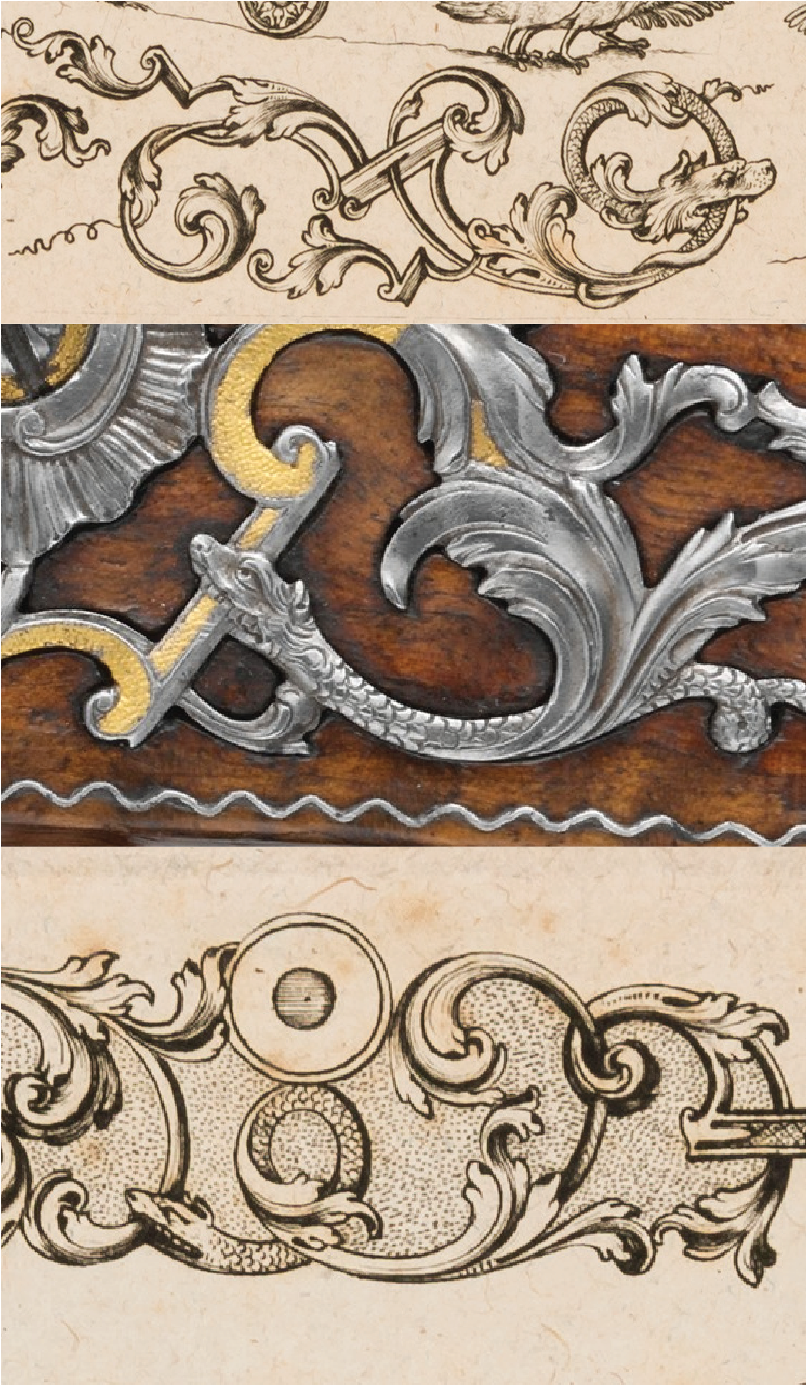
Below is an example of several pages from De la Collombe’s work alongside a finely engraved flintlock long gun by La Faure and Mollier of France, dated 1742. Many of the engravings on this gun are clearly drawn from, or closely follow, the patterns shown here.
At first glance, one might mistake these designs for that of Simonin. But look closer.
The scrolls and c-scrolls begin to change.
Instead of serpents emerging from the ends of leaves, they start to wrap around and grip the stems themselves. The movement is less fluid and more controlled. Rather than always following a smooth spiral, the scrolls begin to tighten, turn more sharply, and occasionally break into straighter lines.
It’s a small shift, but it changes the feel of the entire design.


This detail is where the engraving really starts to come alive. When I first started seeing the faces on the Frizzens in the pattern books, I wondered if I would eventually run across an actual engraving, or if it was just an artistic fantasy. To see that La Faure and Mollier, took on the challenge of such a intricate addition to the engraving is genuinely impressive.

Lastly, and maybe most striking, is this near direct match of the dragon on the stock to the dragon on paper. The design from the print shows up almost exactly in the silver inlay, down to the small turns and fine lines.
It’s a good reminder that even when engravers weren’t creating the designs themselves, the skill was in making them work, taking something 2 dimensional and bringing it to life on the surface of the gun.
By now you can see how the pattern books allowed the inspiration for gun engraving to travel across Europe. A dragon etched onto paper in Paris shows up engraved on a lockplate in England, or worked into the stock of a gun in Germany.
Thus it is undeniable that France and the patronship of King Louis the XIV had a massive influence on the gun engraving world in the 17th and 18th centuries. But at the same time, there was another corner of Europe setting itself apart and revolutionizing new artistic technique. In the next part we will do a deep dive on the firearms engraving that was taking place in Italy during the latter part of the Renaissance and into the 18th century, including the influence of the Medici family in Florence and the amazing lacework scrolls of the masters in Brescia.
Images featured in this article are sourced from the digital collections of The Metropolitan Museum of Art and the Victoria and Albert Museum. Individual object details are available through each institution’s online collection.


Comments